|
|
Book
Five |
Ch.
11.
249 |
|
B |
C |
D |
L |
M |
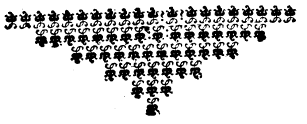
This table consists of three orders of letters.
It would be somewhat more accurate if we should write the middle
order of letters in the first place, the third order in the second place,
and the first order in the last place. I wish this fact to be well noted,
so that what follows may be better understood. The explanation of the
table is this: (1) The Power
of the vowels is transfused into the letters immediately beneath; the
vowels are, therefore, idle in writing.
(2) If, in turn, these letters into which the vowels have been
transfused occur in the sentence which you wish to conceal, their Power is
transcribed into the letters which are written in the second line of the
second order; or, if you use these transfused letters as letters of the
second line, they are clothed in another form. (3) The consonants written in the third order are
mutually |
|
P |
S |
T |
R |
N |
|
|
|
|
H |
|
|
|
|
H is not transposed |
|||||
|
A |
E |
I |
O |
U |
|
|
F |
& |
Q |
L |
Z |
|
|
|
|
|
|
|
|
|
F |
G |
Q |
X |
Z |
|
|
Y |
S |
K |
S |
F |
|
interchanged and transposed one with another. (4) The letter H is not changed, but remains with its own Power. This much being understood, let us now write the following example, in which all the letters are found together:
Gaza frequens Lybicos, duxit Karthago triumphos.
|
Gaza frequens lybicos, duxit Karthago triumphos Sfff yl&kz&mg
rfpqslx
tzsqd qfldhfsl dlqznbhlc
|
|
Inviti non ambientes in Republican collocandi Qmzqdq mlm fnpq&md&c
qm l&bzprqsfm slrrlsfmtq |
The letters in the last place, thus, as seen, transposed, record the famous words of Alexander Severus. Inviti non ambientes in Republican collocandi.