Le blog-notes mathématique du coyote


Extra

Editorial

Ce blog a pour sujet les mathématiques et leur enseignement au Lycée. Son but est triple.
Premièrement, ce blog est pour moi une manière idéale de classer les informations que je glâne au cours de mes voyages en Cybérie.
Deuxièmement, ces billets me semblent bien adaptés à la génération zapping de nos élèves. Ces textes courts et ces vidéos, privilégiant le côté ludique des maths, pourront, je l'espère, les intéresser et leur donner l'envie d'en savoir plus.
Enfin, c'est un bon moyen de communiquer avec des collègues de toute la francophonie.

jeudi 19 novembre 2015

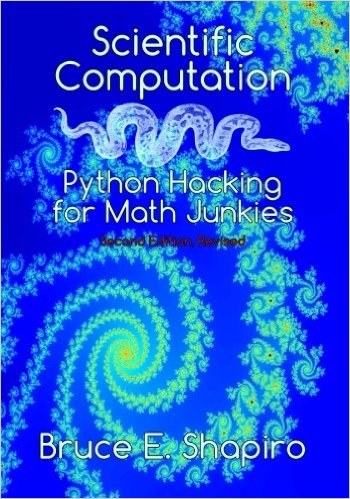
Scientific Computation: Python Hacking for Math Junkies


Scientific Computation: Python Hacking for Math Junkies
Bruce E Shapiro
Sherwood Forest Books
Second Edition (5 juin 2015)

Présentation de l'éditeur
Computers are wonderful things. They improve our lives and produce works of art. Information and communication are free and available in ways that were undreamed of by many a generation ago.
And yet computers inspire fear when they are used improperly or misunderstood.
Everyone uses computers today. The typical student uses at least three: a portable notebook computer, a tablet, and a cell phone. None of these even existed before this year's college graduating class was born. So a reasonable amount of computer literacy is expected of everyone these days.
Though inspired by mathematics, much of the mathematical beauty of computation is largely ignored by both elementary computer science and introductory programming books.
This book is designed to help math junkies - anyone who likes math, studies math, or uses math in their daily life - learn about computation. The emphasis is on algorithms. It is appropriate for students with no prior programming experience as well as professional scientists.

mardi 17 novembre 2015

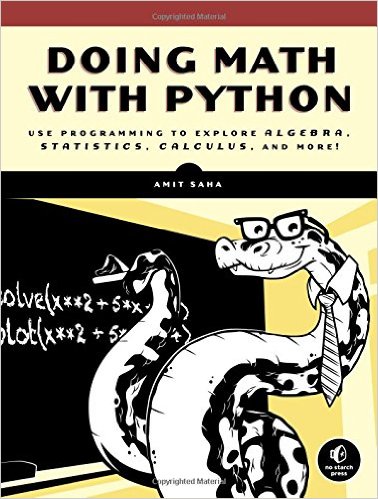
Doing Math with Python


Doing Math with Python
Amit Saha
O'Reilly (31 août 2015)
304 pages

Présentation de l'éditeur
Doing Math with Python shows you how to use Python to delve into high school—level math topics like statistics, geometry, probability, and calculus. You'll start with simple projects, like a factoring program and a quadratic-equation solver, and then create more complex projects once you've gotten the hang of things.
Along the way, you'll discover new ways to explore math and gain valuable programming skills that you'll use throughout your study of math and computer science. Learn how to:

  • Describe your data with statistics, and visualize it with line graphs, bar charts, and scatter plots
  • Explore set theory and probability with programs for coin flips, dicing, and other games of chance
  • Solve algebra problems using Python's symbolic math functions
  • Draw geometric shapes and explore fractals like the Barnsley fern, the Sierpinski triangle, and the Mandelbrot set
  • Write programs to find derivatives and integrate functions
Creative coding challenges and applied examples help you see how you can put your new math and coding skills into practice. You'll write an inequality solver, plot gravity's effect on how far a bullet will travel, shuffle a deck of cards, estimate the area of a circle by throwing 100,000 "darts" at a board, explore the relationship between the Fibonacci sequence and the golden ratio, and more. Whether you're interested in math but have yet to dip into programming or you're a teacher looking to bring programming into the classroom, you'll find that Python makes programming easy and practical. Let Python handle the grunt work while you focus on the math.

mardi 10 novembre 2015

Graphiti - L'inspecteur Manori enquête à Paris


Graphiti - L'inspecteur Manori enquête à Paris
Alain Hertz
Ed. Amalthée (25 octobre 2014)
334 pages

Présentation de l'éditeur
Un tueur en série terrorise la France depuis plusieurs mois et mobilise toutes les polices de l’Hexagone. Il agit sur tout le territoire et toujours selon le même mode opératoire : de nuit, il attaque des jeunes d’une vingtaine d’années qu’il drogue avant de les étrangler. Il signe ses crimes de façon singulière par le mot « graphiti » en lettres capitales rouges. Le jour où le commissaire chargé de l’enquête découvre un dessin sur la scène d’un nouveau crime, il décide de faire intervenir l’inspecteur Maurice Manori, de l’Institut de Police Scientifique de Montréal. Ce dernier, capable de résoudre une enquête en dessinant des points et des traits sur une feuille, saura-t-il démasquer le criminel ?
Alain Hertz enseigne les mathématiques à l’École Polytechnique de Montréal. Sa passion pour les énigmes et intrigues mathématiques l’a certes conduit à sa carrière de professeur et de chercheur, mais aussi à créer des personnages peu reluisants, que traque son alter ego à la logique mathématique implacable. On a fait sa connaissance dans L’Agrapheur – Intrigues policières à saveur mathématique, le premier ouvrage de l’auteur.

dimanche 1 novembre 2015

Eloge des mathématiques


Eloge des mathématiques
de Alain Badiou, Gilles Haéri
Flammarion (16 septembre 2015)
124 pages

Présentation de l'éditeur
Découvrez Éloge des mathématiques, le dernier ouvrage du philosophe Alain Badiou, écrit à 4 mains avec Gilles Haéri ! Ce dialogue entre les deux auteurs se présente comme une introduction très accessible à ce que sont les mathématiques, et il explore l’influence décisive qu’elles ont toujours exercée sur les plus grands philosophes. Plus encore, il est l’occasion d’une défense engagée et philosophique du rôle que jouent les mathématiques dans notre bonheur. Ce livre interpellera forcément tous les passionnés de mathématiques et de philosophie !